
|
Getting your Trinity Audio player ready...
|
VIDEO and POWERPOINT.
May 11th, 2020, SAM Agenda
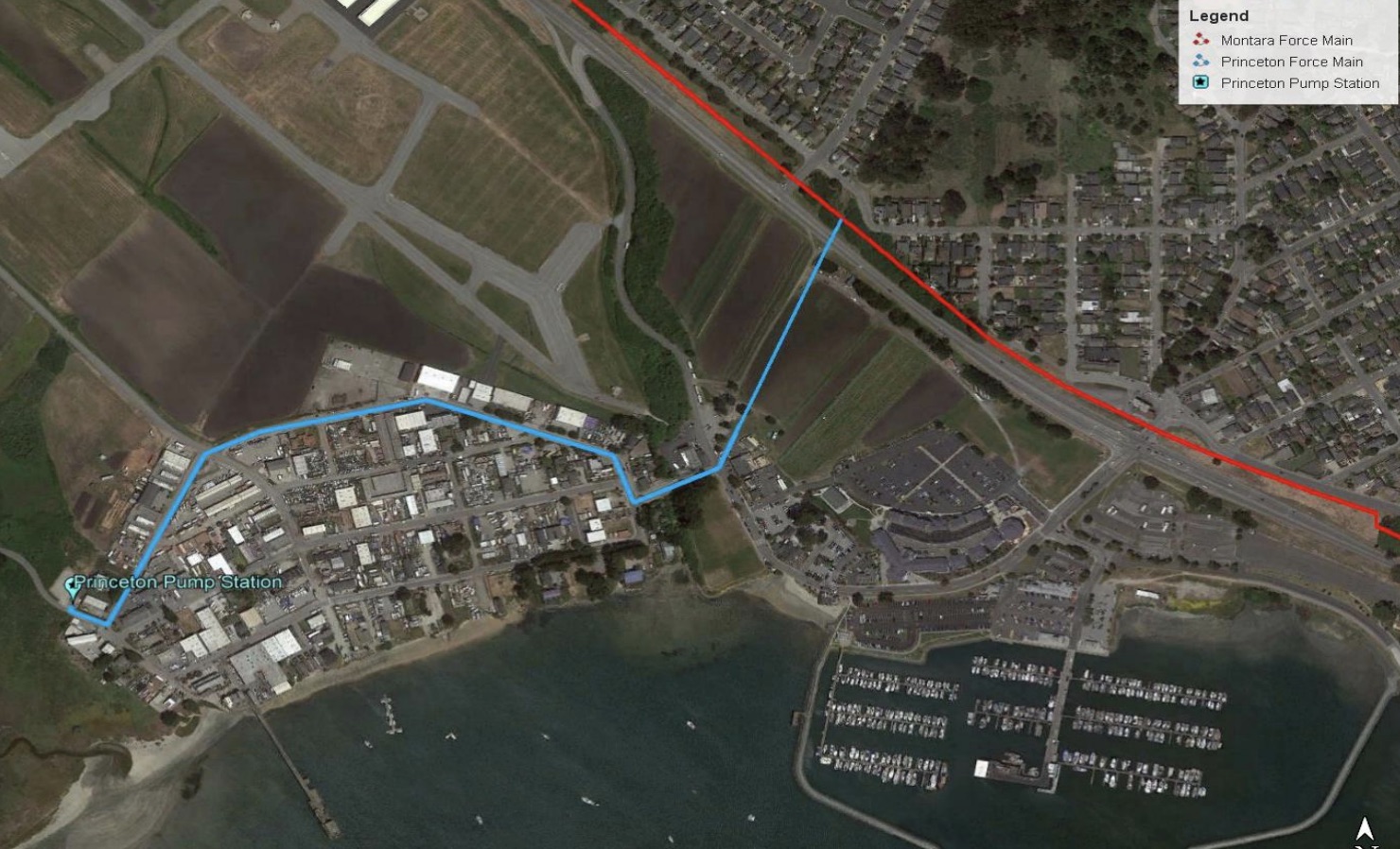
Princeton Force Main Presentation
Princeton Force Main Presentation by Sewer Authority Mid-Coastside’s General Manager, Kishen Prathivadi.
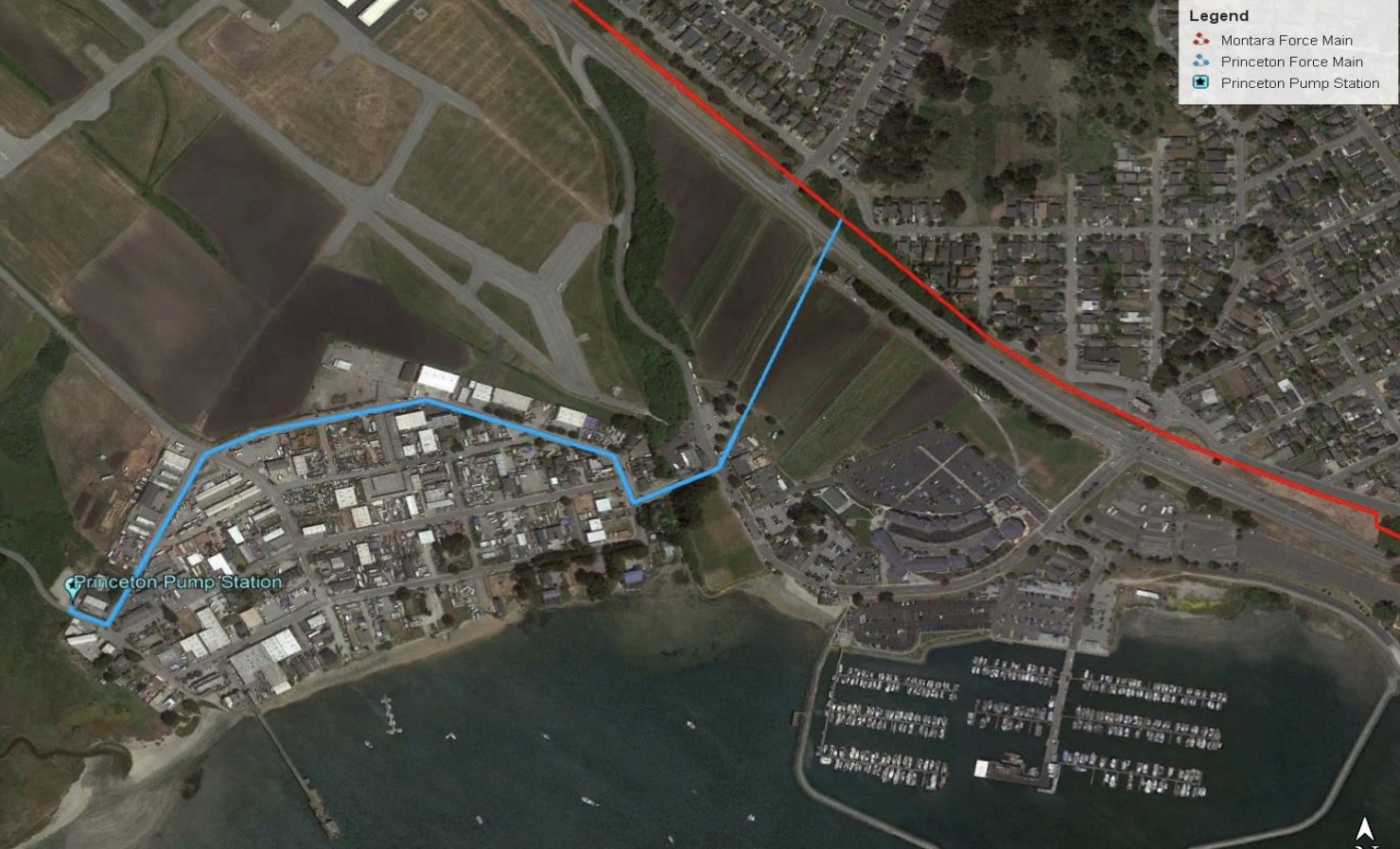
PRESENTATION OUTLINE
1. Purpose
2. Condition assessment team
3. Overview of Princeton Force Main
4. Methodology
5. Hydraulic assessment
6. Geologic assessment
7. External inspection process
8. Metal thickness test results
9. Soil and groundwater test results
10. Recommendations
11. Questions/discussion
CONCLUSIONS
• The Princeton Force Main appears to be in good condition and does not pose a threat of failure
• The pressure rating of the Force Main far exceeds the normal working pressure
• No hydraulic anomalies were observed
• There are no observed surface indications that the Force Main is leaking
• No development or other utilities are jeopardizing the Force Main • No faults or geologic hazards pose a threat to the Force Main
• Soil and groundwater surrounding the Force Main are not corrosively aggressive
• Metal loss is moderate and does not pose of risk of failure
• There is no reason to believe the Force Main will have any less than a 100-year service life which is expected of a ductile iron pipeline
RECOMMENDATIONS
• Perform similar inspection in 10 years
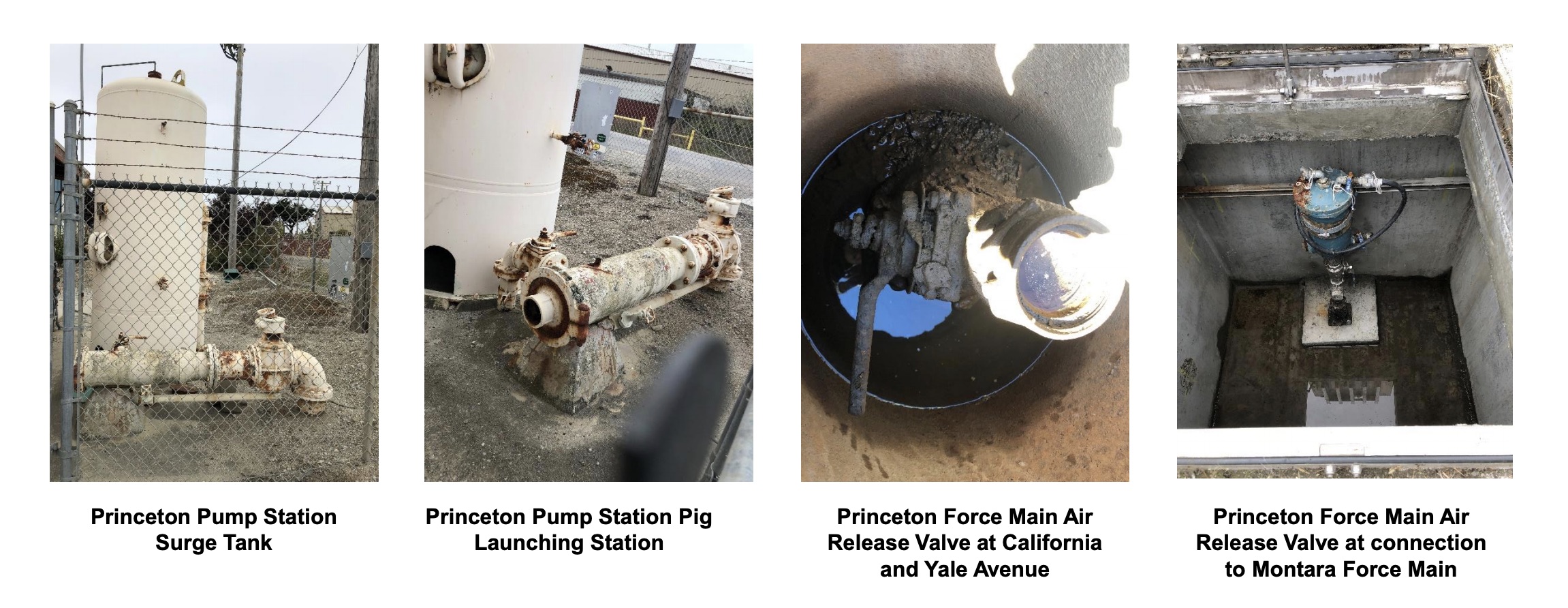
• Air release valves and blow off should be on a regular maintenance schedule
• Replace deteriorated surge tank at Princeton Pump Station
• Replace the other ARV on the force main alignment
• Install emergency bypass capability at Princeton Pump Station
Watch remotely. Comments and questions by email.
Agendas and Zoom Links
SAM Meeting Videos via Pacific Coast TV
Contact Us
Our Mailing Address is:
Sewer Authority Mid-Coastside
1000 Cabrillo Hwy N.
Half Moon Bay, CA 94019
(650) 726-7833 (fax)
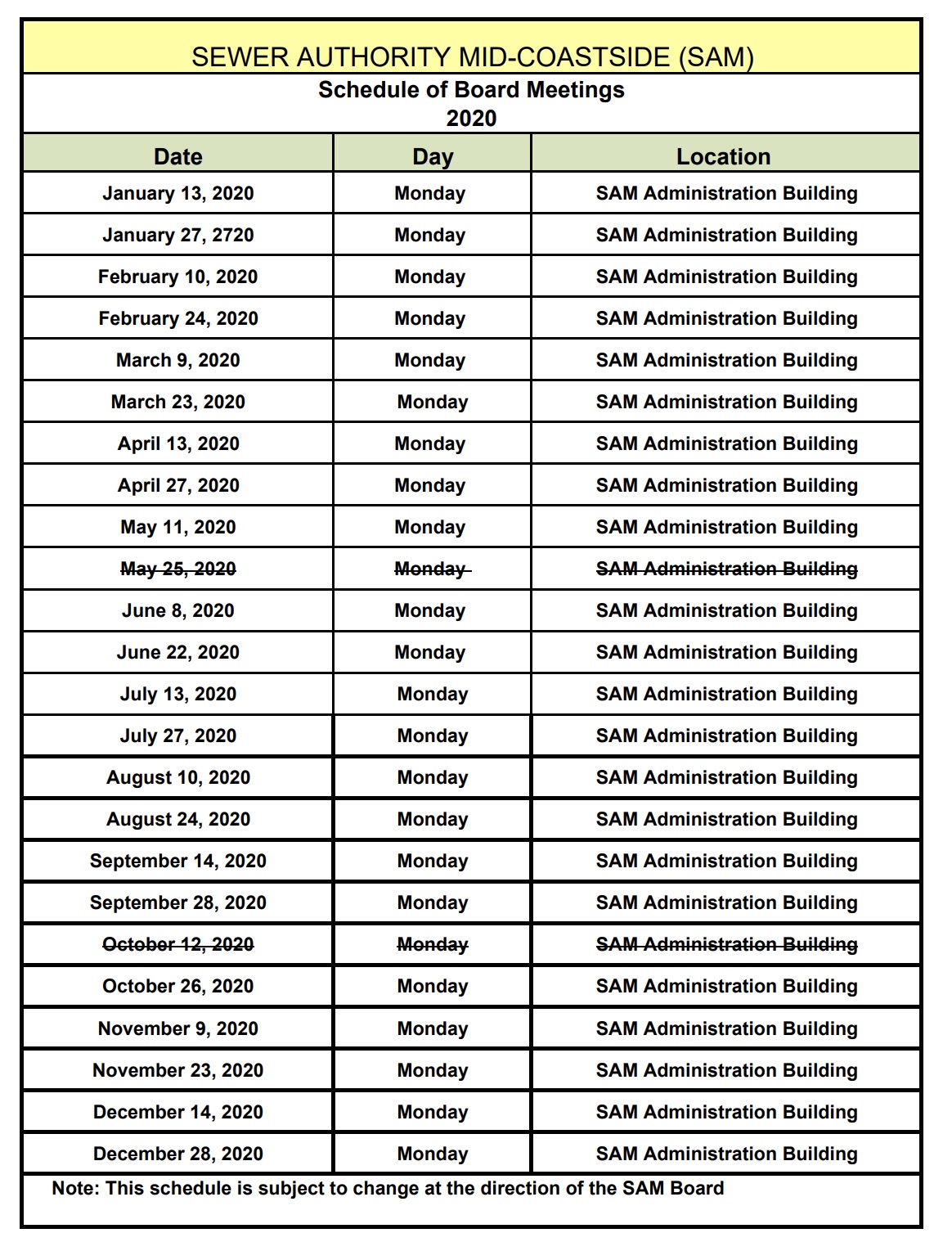
Regular Board Meetings are on the 2nd and 4th Mondays of each month at 7:00pm.
From time to time a meeting date may be changed, cancelled or relocated. Check the posted agenda for any changes to the normal schedule (click on links below).
The Sewer Authority Mid-Coastside (SAM) provides wastewater treatment services and contract collection maintenance services for a population of approximately 27,000 in the following areas:
- City of Half Moon Bay
- El Granada
- Miramar
- Montara
- Moss Beach
- Princeton by the Sea
SAM Directors
Dr. Deborah Penrose
Director, Representing City of Half Moon Bay
Kathryn Slater-Carter
Chair, Representing Montara Water & Sanitary District
Barbara Dye
Vice Chair, Representing Granada Community Services District
Deborah Ruddock
Secretary/Treasurer, Representing City of Half Moon Bay
Ric Lohman
Director, Representing Montara Water and Sanitary District
Jim Blanchard
Director, Representing Granada Community Services District
Trash Wipes and Rags; Do NOT Flush. Cost For Repair?
VIDEO. Two pump failures in last two weeks.
Wipes and rags, as seen below, are the culprit.

Talk to your neighbors, please.
Repair for one pump can be $50,000.
Replacement is very, very expensive. A new pump can be a million dollars.
Burning out a generator can cost $100,000 to replace
~ Montara Sewer and Water District’s (MSWD) Board Member Kathryn Slater-Carter and MSWD General Manager, Clemens Heldmaier.
VIDEO.
Core facts:
- Water use is going down. Currently, sewer rates are based on water consumption.
- Sewers costs are going up due to modern environmental requirements.
- Nationwide, all infrastructure is 80-40 years old and needs to be replaced.
Rates are currently based on water consumption. Because water consumption is going down, Public Works is suggesting the City of HMB go to flat rates for sewer billing. The flat rate will be connected to the actual cost of sewer infrastructure operations and maintenance, resulting is less stagnation of rates, followed by sharp increases; a more even flow ;-).
Newly added to the rate structure are rates created for deed restricted senior apartments, mobile homes and ADU’s which will result in a reduction for many.
John Doughty, HMB Public Works given an excellent logical presentation.
NEXT HMB CITY COUNCIL PUBLIC MEETING
APRIL 7th, 2020
Watch and contact John by email if you have comments of questions.
See how the sewer rates are static for years, then there has to be big increases

Wastewater and Microgrids for the Coastside? No More Inter-Tie or Outfall!?
POWERPOINT/ LINKS. This is the presentation made to Renewit group led by Stanford Civil Engineering in 2016. It deals with work previously completed in Santa Monica, Malibu and Ventura County on small modular fully automated and remote controlled sewage treatment in areas where central plants and septic systems failed or could not function.
I have been studying, designing and installing such systems since 2000. I also worked on designs for very large systems way back when designing airports in remote desert areas.
~ Rinaldo Vesalisa, architect, LEED.

Rinaldo Veseliza
Smaller Is Better: The Solution to California’s Ancient Water Pipes
Our aging infrastructure is a ticking time-bomb underground. We can begin to help repair it and stave off future trouble by reaping the benefits of smaller, decentralized microgrid systems.
WRITTEN BY Rinaldo Veseliza
PUBLISHED ONs Mar. 16, 2017
READ TIME Approx. 3 minutes
A system at the San Francisco Public Utilities Commission helps recycle water for on-site reuse for irrigation and other needs.Tara Lohan
AS A PRACTICING architect and LEED AP (Leadership in Energy and Environmental Design, Accredited Professional) for more than 40 years, I have scoured the planet for technological solutions to improve sustainability with water, energy and waste treatment. During the course of my projects, I often see the underbelly of the beast where aging underground systems have the potential to erupt at any time, particularly in earthquake-prone areas such as California’s San Francisco Bay and Los Angeles.
Our greatest current and growing problem is restoring and improving infrastructure systems to last another 50 years. We cannot fix all the massive underground problems, but we can instead replace them with smaller, local surface-mounted solutions that will lead us to more flexible, manageable, decentralized and sustainable systems.
It is the equivalent of, in communication technology, switching from giant mainframes to using cellphones. The technology is all available, automated and user-friendly. Microgrid technologies started with NASA space missions where astronauts recycled all their waste into water and created their own power on board. It is now time to apply our inventions and sustainability principles through our communities to a larger spaceship – our planet.
The infrastructure started in primitive little towns across the world, then septic systems were replaced by larger central plants and distribution systems as cities grew. Waste treatment plants were moved away from town centers to where the smell could be dissipated and tolerated. As cities grew, all the infrastructure expanded into a massive network to manage everyone’s needs.
Today, as much of this infrastructure is dated, landlocked or falling apart, we should consider reverse-engineering the concept of distribution so that small communities, large buildings and individual homes can provide their own water, renewable energy/power (and storage) as well as waste-water treatment.
It is difficult to fix hundreds and thousands of miles of underground piping that we cannot see. Most municipalities do not even acknowledge its existence, especially in times of economic difficulties. Deferred maintenance has been a problem in cities worldwide.
Centralized systems were great, big, expensive and “permanent” solutions for growing communities during their earlier development.
Now, as these overgrown, dense cities are overwhelmed with growing populations, we need smaller-scale microgrids, which can remove the mystery of processing stormwater and sewage water into usable/potable water with self-contained prefabricated modular systems and automated quick-response services. Decentralized waste-water processing and recycling microgrids will actually create many more jobs than our current central systems. They will also reduce the potential impact of cyber attacks and massive system outages.
For example, for about $3,000, a traditional home can be outfitted to recycle 80 percent of its waste-water and use it locally, reducing the need for potable water by that same amount. Office complexes can treat and recycle their own waste to 80 percent recycling onsite for irrigation, toilets and cooling systems. City blocks can also recycle their waste-water locally and reprocess it mechanically to re-use onsite, significantly reducing costs for upgrading their failing underground piping.
These smaller-scale solutions can each reduce the need for potable water by 80 percent, which would be a major accomplishment for our society. They exist now and should be utilized in all future buildings as well as retrofitted.
In a city with many hills like San Francisco, where pumping uphill can be costly, the local solution can solve many current problems, including savings in replacement costs, increases in efficiency and greater flexibility with maintenance and operations. The technology has been around for a long time, but municipal politics has prevented any such conversions, often citing potential public health risks as the main reason for not abandoning existing centralized plants.
Yet the aging, leaking underground sewage pipes are causing growing numbers of system spills which have a significant impact on public health. We cannot see all the damage caused until it is too late, after our underground water sources are polluted. Many municipal systems are finally looking into recycling a small percentage of the water they currently process and dump.
Refurbishing our existing communities, buildings, homes and infrastructure is a massive undertaking. However, with newer technologies at lower costs, we can re-design our own facilities but also export the collective knowledge throughout the world. As usual, the Europeans are somewhat ahead of the game because of visionary/mandated governmental initiatives to improve efficiency, particularly with solar photovoltaic, wind, hydroelectric, waste-to-energy plants and biomass power generation. We have made great progress in recent years in re-inventing our building technologies and reviving our leadership in engineering.
Solar power is the best example of technology that is already modular, local and self-supporting, providing our energy needs at source, creating the opportunity for microgrids to replace long-distance power transmission systems and associated inefficiencies. Smaller is better.
Never miss an update. Sign up here for our Water Deeply newsletter to receive weekly updates, special reports and featured insights on one of the most critical issues of our time.
About the Author
ARCHITECT AND DIRECTOR OF SUSTAINABILITY, ALISTO ENGINEERING GROUP


Other Links
-
Wastewater and Microgrids for the Coastside? No More Inter-Tie or Outfall!?
- Video. SAM Employees Give BIG Thanks to General Manager Beverli Marshall for Her Four Years of Service.
- Video. What is ElectroScan & How Can it Help Sewer Authority Mid-Coast (SAM)?
- PODCAST. Managing sewage is the most important job on the planet ~Freakonomics: In Praise of Maintenance.
- Video. SAM Reports Zero Sewer Spills on the Coastside in 2018
- Video. SAM Meeting 4/22 ~ Partners with PG&E to Reduce its Carbon Footprint
Powerpoint of SAM Tour, courtesy of Tim Costello, SAM:


Author: mdrag
x